
Moreno Valley Previous Residents by Era
Previous residents appear in different sources by era. The assessor fixes parcel identity; the recorder traces transfers; directories and census schedules add names at an address; permits mark changes to the structure. Moreno Valley incorporated in 1984 from Moreno, Sunnymead, and Edgemont, so older entries may use a predecessor place name or a Riverside County enumeration district.
| Source | Years It Covers | Where Held | What It Shows |
|---|---|---|---|
| Riverside recorder web index | Jan. 1, 1974-present | Riverside ACR web self-service | Party name, document type, date, number, and copy ordering |
| ACR office computers | 1975-present | Riverside County ACR offices | Index access and record images |
| Pre-1975 deed books | Through 1974 | Gateway Riverside, 2724 Gateway Drive, Riverside | Grantor/grantee books, instruments, and legal descriptions |
| Assessor annual roll | Current, as of Jan. 1 | Parcel facts online; owner at an ACR office | APN/PIN, situs, legal and map facts, assessed owner |
| Riverside directories and criss-cross examples | 1947, 1951, 1952, 1955, 1963, 1966 cited | Libraries, reports, and FamilySearch | Listed name, address, and occupation where printed |
| Federal census | 1790-1950; 1950 newest public | NARA and genealogy databases | Named household, relationships, and enumeration district |
| City permits | Coverage unpublished | Moreno Valley CDD and CPRA requests | Work dates, applicant, contractor, and project descriptors |
| Obituaries and probate | 2001-2006 local obituaries; probate by case | Genealogical Society and Riverside Superior Court | Death and family leads, petitioner, or heir trail |
Start with the current parcel when the address is known. Hold that identity steady, then use deeds for ownership changes and historical sources for people. A missing year calls for another source or spelling.
Moreno Valley Resident Records Start With Parcels
Use the free Riverside County assessor search with one key at a time. Enter the street number plus street name. APN means assessor parcel number. A PIN, or assessment number, uses the first nine digits only, without its dash or check digit.
| Search key | What to enter | What the result contributes |
|---|---|---|
| Property address | Street number and street name | Situs, parcel placement, and assessment facts |
| APN | Parcel number in the assessor format | Stable parcel reference and map/legal links |
| PIN | First nine digits; omit dash/check digit | Assessment identity and related parcel data |
Results can show APN or GeoCode, situs or “No Situs,” property type, legal description, subdivision, lot or parcel, map book and page, value history, similar sales, tax information, and a property report. Owner name and mailing address are not shown online. The January 1 annual owner list is open for inspection at an assessor office. Use that counter fallback when a deed search needs the current owner.
The county office's Assessor-County Clerk-Recorder page is the official starting point for the parcel side of a Moreno Valley address.
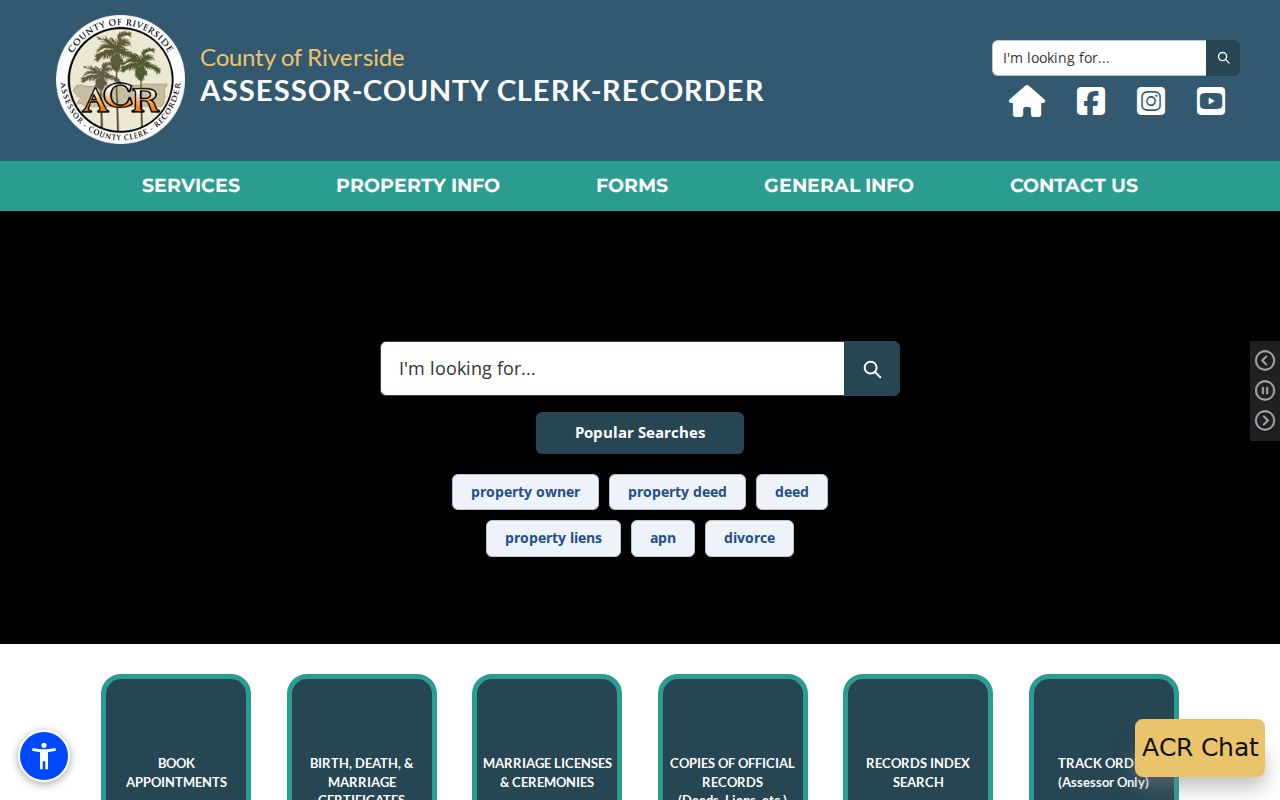
The assessor view anchors a past-resident search to a parcel rather than to a guessed name. Keep the APN, PIN, situs, and legal description together before moving to the recorder.
Trace Moreno Valley Deed Records
Riverside County's recorder index is name-based, not an address or APN index. Its advanced recorder search offers document number, date range, party name, document type, map type, and book/page modes. Search the current owner as grantee, confirm the instrument, then use its grantor as the next grantee.
- Normalize the street address in the assessor search and save the APN, PIN, and full legal description.
- Obtain the current annual-roll owner at an ACR office, because the web parcel result suppresses the owner name.
- Search that owner as grantee in the recorder index, narrow the date and deed type, and confirm the APN and legal description in the instrument.
- Take the grantor from the confirmed deed and search the same party as grantee within an earlier date range.
- Repeat the seller-to-buyer loop while checking the document number, recording date, party spelling, and legal description at each link.
- At the pre-1975 edge, move to Gateway Riverside's books and images, then connect the last verified instrument to the older legal description.
Continuity matters more than a long name list. A deed shows a transfer and legal interest, not every person at an address. Keep the legal description because old street and community labels may change.
- Grantor
- The person or organization transferring an interest in the recorded instrument.
- Grantee
- The person or organization receiving that interest.
- Chain of title
- The connected sequence of recorded transfers that links later title back to earlier parties.
- Legal description
- The formal parcel description used in the instrument, often more durable than a street address.
The county's Assessor-County Clerk-Recorder FAQ explains the split between online parcel facts and office ownership inspection.
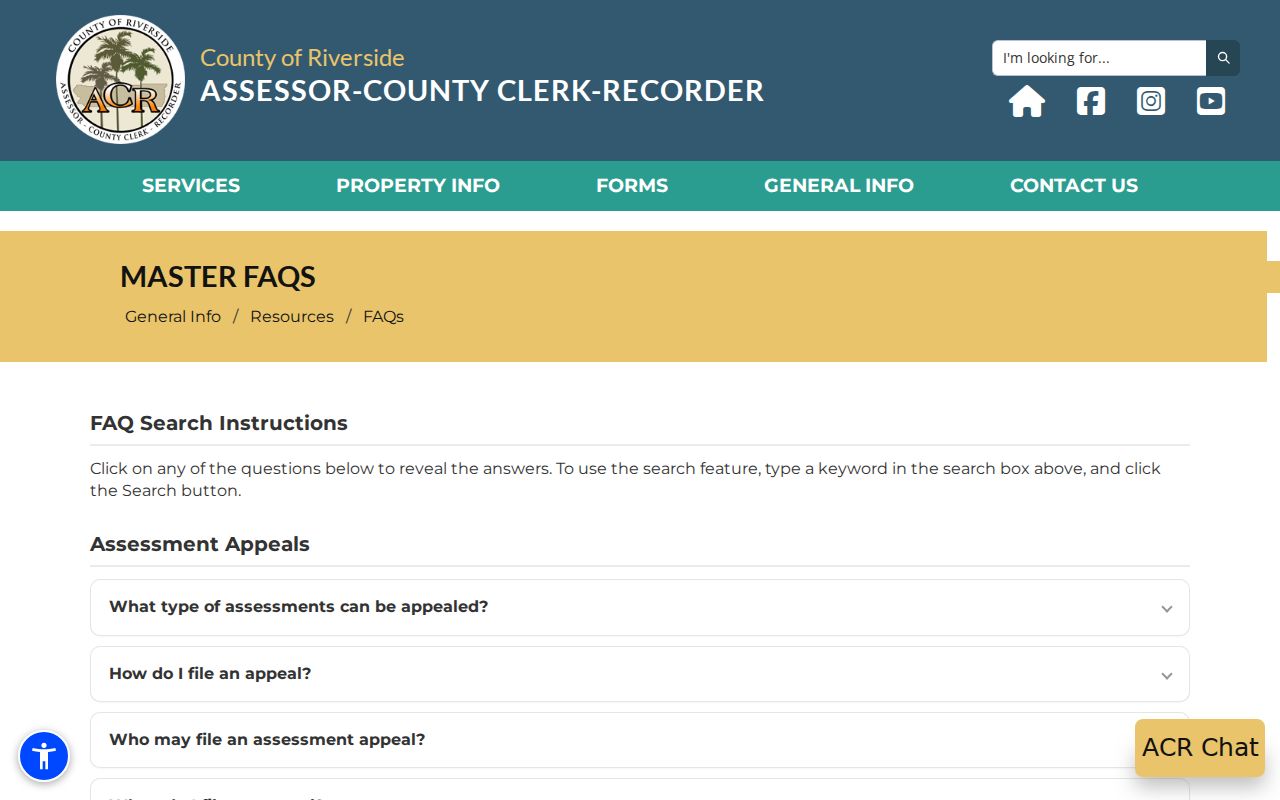
The parcel hit is a lead, not a full list of previous residents.
Moreno Valley Previous-Resident Copy Routes
The recorder date boundary has a one-year split. Web search runs from Jan. 1, 1974 to present. Office computers reach 1975; 1974 and earlier research belongs at Gateway Riverside, 2724 Gateway Drive, Riverside. Keep that distinction when a search stops.
Four access channels are documented for record copies. Choose the route that matches the instrument's age and identifier.
- Online: search, select, and order a regular or certified copy through the web service.
- Mail: provide title or type, complete party names, estimated recording date, and parcel number. Without a document number, a pre-1976 request is limited to two years after the estimate.
- Drop box: submit a prepared copy request through the county channel.
- Counter: use an office terminal for index and images; same-day copies are typical unless research is extensive or old.
Copies cost $8 for the first page, $1 for each additional page, and $2 for certification. Online processing averages 48 hours, then mailing. Card surcharge is 2.15%; completed copy fees are not refundable. An NTE, or “not to exceed,” check can cover uncertain page totals.
The county's record-copy instructions explain ordering after an index search.
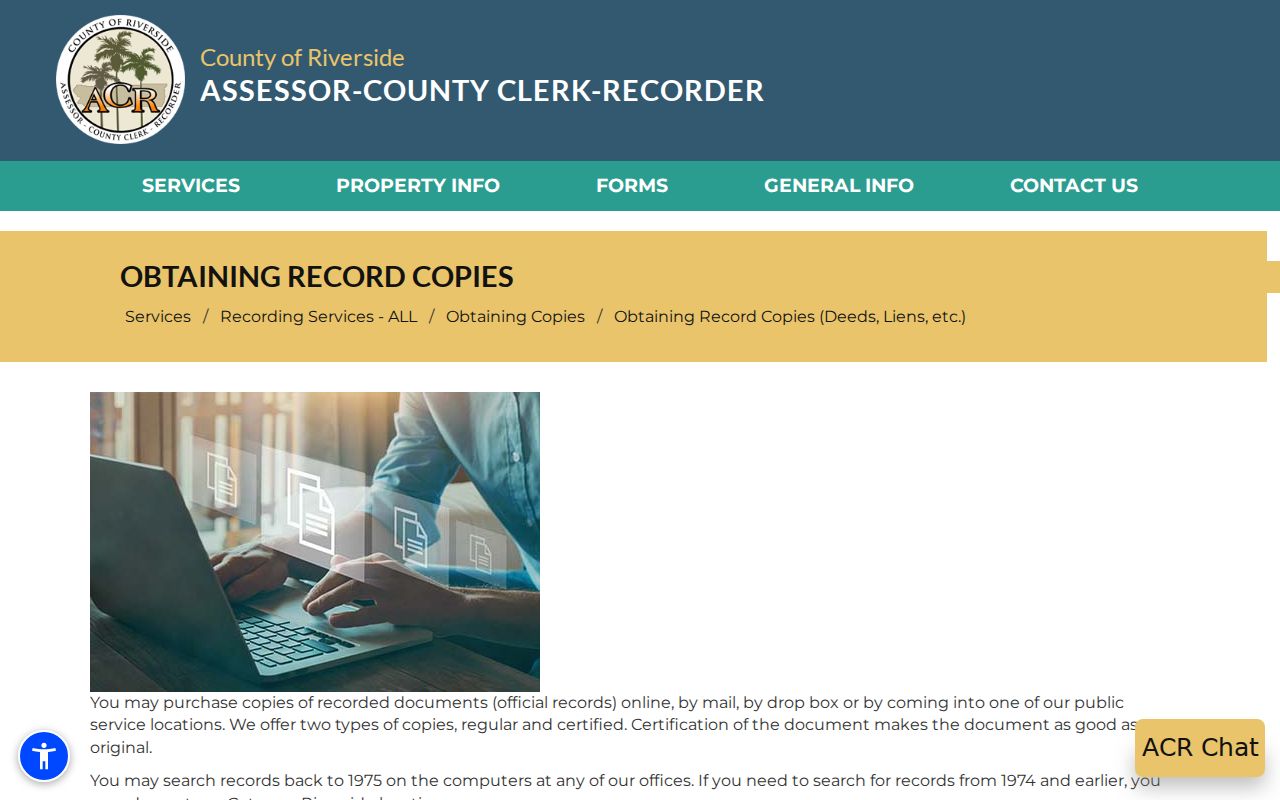
Check the instrument before paying: the image confirms parties and legal description.
The county's official record-copy service also accepts prepared requests.
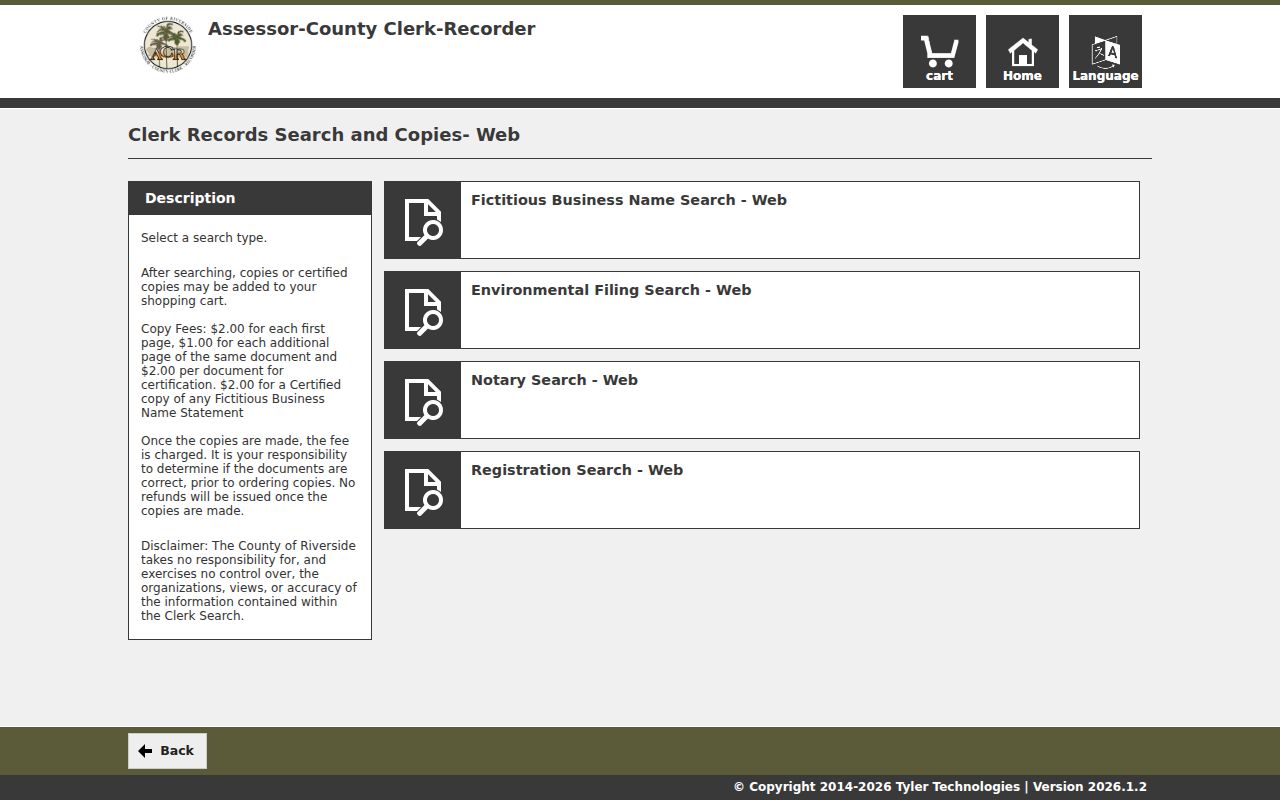
For a pre-1975 Moreno Valley deed, Gateway or the counter is part of the plan.
Moreno Valley Previous Residents in Directories and Title
Deeds show transfers; criss-cross directories show listed names at addresses. Riverside evidence cites Los Angeles Directory Company volumes from 1906-1955, including 1947 and 1951, and Luskey examples from 1951, 1952, 1955, 1963, and 1966. These are examples, not a continuous Moreno Valley run. The city directory collections page covers the broader shelf.
- Criss-cross directory
- A reverse reference read from address to listed householder, then checked in the alphabetical name section.
- Listed occupant
- A person printed beside an address in a directory; the entry is not proof of title or a complete household.
- Title record
- A recorded instrument that identifies parties to a transfer and the legal parcel description.
Read the address side, copy exact spelling and street wording, then check the alphabetical section. A missing entry may reflect a move, death, omission, spelling change, or unpublished listing. Test it against another dated source.
1950 Census and Moreno Valley Residents
Pair years rather than treating a directory as a census. The National Archives 1950 Census is the newest public federal census under the 72-year rule. The nearby NARA Riverside genealogy service offers free database access and help with census, land, naturalization, military, immigration, and federal court sources.
- Pick the directory or telephone year nearest the event, such as a 1947 or 1951 Riverside example.
- Search 1950 census terms Moreno, Sunnymead, Edgemont, Alessandro, and Riverside County, not only the modern city name.
- Locate the enumeration district and compare address, names, relationships, and any directory occupation field.
- Mark conflicts as questions: a changed name or address can reflect a move, omission, spelling change, or another household.
- Bridge later years with the APN, deeds, permitted work, obituaries, and probate.
Because incorporation came in 1984, use predecessor place names. A 1950 household may be indexed under a community term absent from the modern address. An enumeration district is a census canvass area, not a modern neighborhood boundary.
- Enumeration district
- The geographic unit assigned to a census taker for a particular census, year, and place.
- Directory year
- The publication year of a name, address, or telephone volume, which may not match the year of a deed or census visit.
Moreno Valley Resident Trail Endpoints
Permits can date a building without naming each resident. The Moreno Valley Community Development hub links to permit, planning, code, SimpliCITY, and property searches. Coverage is unpublished, but address-keyed permits may show work date, applicant, contractor, and project. Plans are viewable on premises; CPRA can request existing records. Active code matters may be redacted.
- Use the Community Development hub for available address searches.
- For a missing plan or permit, submit a narrow City Clerk request with address, record type, and date range.
- Extensive land-development research typically takes 10 business days or longer; grading and erosion-control plans go through City Clerk.
The Moreno Valley Genealogical Society holds local obituaries for 2001-2006 and a Perris Cemetery grave directory at the Moreno Valley FamilySearch Center. Listed hours are Tuesday through Thursday, 9 a.m. to noon, with other times by appointment; verify access. Probate may lead from a name search to a case, petition, notices, petitioner, or heir. Riverside Superior Court provides case data; certified copies come from the clerk in person or writing.
The Moreno Valley Courthouse page identifies public viewing computers, a clerk counter, and a drop box.
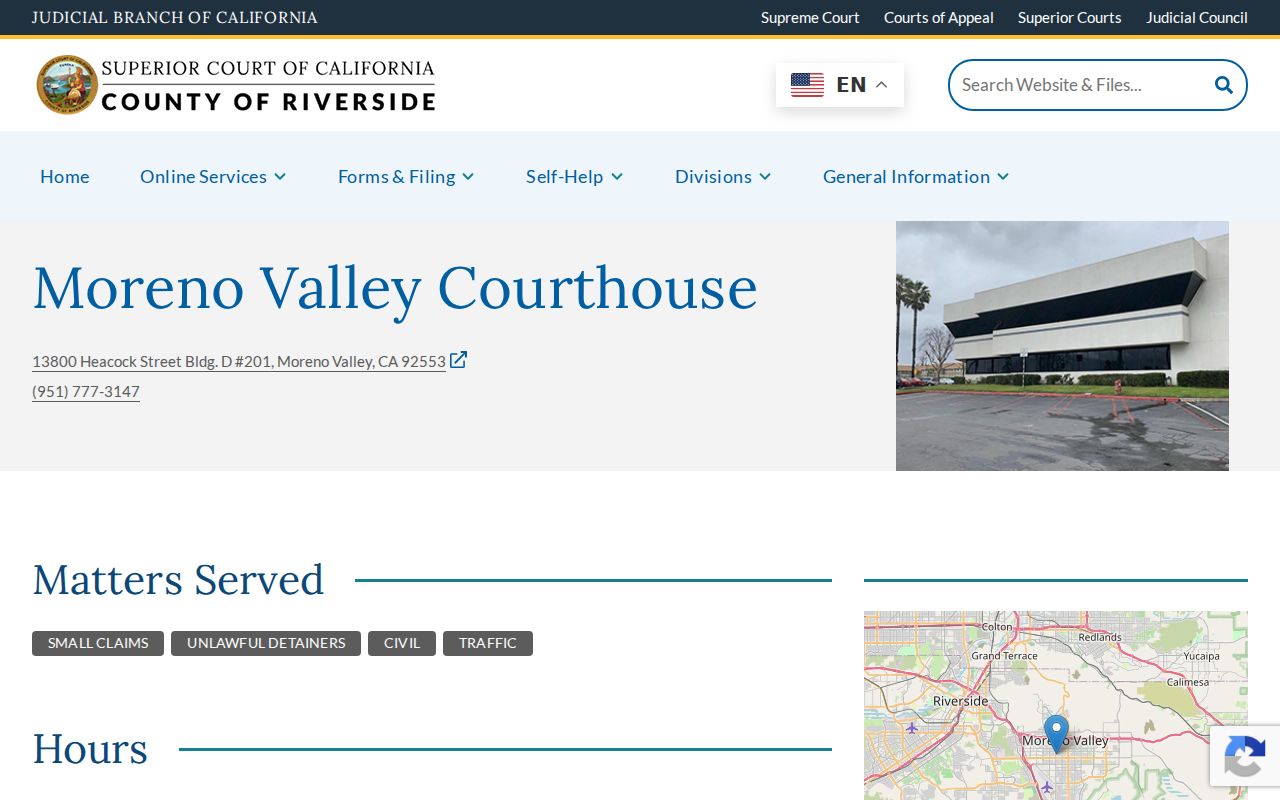
The courthouse at 13800 Heacock Street handles small claims, civil, and civil traffic matters. Other Riverside County cases may be filed elsewhere, so confirm the division and case number.
Moreno Valley Previous Residents and Moved Houses
Moreno Valley has a local reason to keep the parcel and the building as separate research questions. After the 1899 water-rights loss and drought, city history says some expensive houses were moved by steam tractor to Riverside, while others were stolen when owners were away. A building's physical trail can therefore split from its original parcel trail.
For an older address, retain the legal description and APN, then compare permit dates, deeds, and historical accounts. A later Riverside address may relate to the structure without being a later owner of the Moreno Valley parcel. It is a prompt, not proof.
Lawful house history. Use deeds, directories, census records, permits, obituaries, and probate for family history, architectural history, or personal curiosity. Respect sealed and confidential records, and never use a past-resident lead to follow, threaten, stalk, or harass a living person.
Gaps in the Moreno Valley Trail
Some gaps are documented limits, not invitations to guess. No authoritative Moreno Valley, Sunnymead, or Edgemont city-directory run was established. The local reverse-directory shelf and call numbers, a confirmed Moreno Valley Sanborn map series, and a dedicated library house-history guide were not exposed. The library pages also do not publish a definitive obituary index or a dedicated genealogy-room inventory.
Ask the Moreno Valley City Library to check its catalog and electronic resources, some of which require a library card and PIN. The Main, Mall, and Iris Plaza branches can confirm current holdings and access rules. The Moreno Valley Historical Society preserves photographs, firsthand narratives, and ephemera, but it does not publish a full finding aid or fee schedule. The Genealogical Society can confirm its obituary and cemetery materials.
Record the source, year, URL, document number, party role, APN, and uncertainty. This keeps a Riverside County house history useful when evidence ends at a cutoff or protected record.